University of Minnesota Athletics
Immoveable Objects: Gopher Seniors Derek Burns and Ryan Roth
10/26/2001 12:00:00 AM | Football
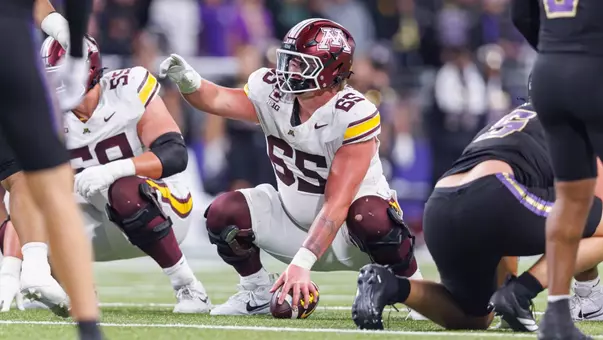
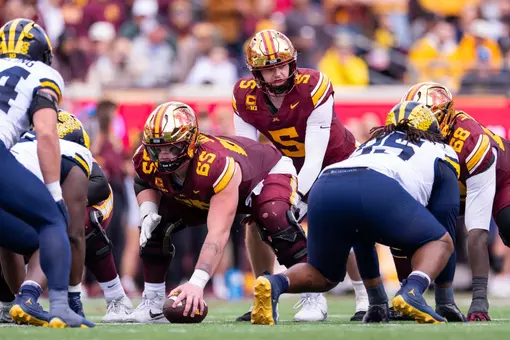
Two seniors on the Minnesota offensive line have come from different backgrounds to play out a childhood dream. One hails from a football powerhouse here in Minnesota. The other comes from a high school in St. Louis, Missouri where in his words, "Our football team wasn't very good." One used to be a fullback when he was in ninth grade and the other a kicker during his high school years. The days of carrying the ball on fourth and inches or kicking the ball through the uprights are long gone. Now, both team up on the Golden Gopher offensive line and have become two "Immovable Objects".
BURNING THROUGH THE CENTER
Eden Prairie football is synonymous with dominance and winning. Over the past decade, they have been the class of Minnesota prep football. Churning out one Division I prospect after another has made it a hotbed for football talent. This season, one of Eden Prairie's finest offensive lineman closes the book in his stellar Minnesota career. During Derek Burns' freshman season at Eden Prairie, two of the dominant players to come out of its program were in the backfield. Jay Foreman was the halfback and Leroy McFadden the fullback. Foreman is a starting safety for the Buffalo Bills and McFadden played at Michigan State.
With Foreman graduating that year, the thought was they would move McFadden to halfback and get a new fullback. On the freshman team, Burns was the starting fullback in hopes he would be groomed to start in place of McFadden the following season. His new role didn't get off to the best of starts as he fumbled his first hand off. After that, he never fumbled again as he racked up over 25 touchdowns and rushed for over 150 yards a game. Most of the time it took three men to bring him down. In his sophomore year, his move to starting fullback never materialized. The team was in need of offensive linemen and Coach Mike Grant felt Derek had a better shot playing college ball if he was on the offensive line. It looks like the move worked out for the best and that can be reaffirmed every Saturday when he is dominating opposing nose guards.
Imagine being dominant on the high school field and then attending your first college practice and realizing how much work needs to be done before you could get your chance on the field. That was the situation facing Burns when he went through his first practice for the Gophers. He was an excellent high school player, but in order to achieve that success at the college level he would need to gain weight and strength, and become a smarter football player. As his weight and height increased, so did his position on the depth charts.
Weighing 260 pounds on a high school football team will likely never leave you overmatched on the field. Weighing that on a Big Ten football field is another story. After his first practice, because of his weight Burns felt overmatched but knew to improve he needed to gain weight and add strength. "After my first practice, I was a bit overwhelmed. Never before had I been overmatched the way that I was, but I think most offensive linemen coming into college are undersized. I knew I had a lot of growing physically to do and that first practice made it crystal clear to me."
After seeing limited action his freshman season, he came into his own the next year. After starting the year behind veteran Pat Hau, a bulkier and stronger Burns got the first start of his career against Wisconsin. It was there all the stories he had heard about Big Ten football were confirmed. "Physically, it is quite a bit different than high school. Guys at every position at this level are both quick and strong. That goes for a defensive nose guard just as much as it goes for a safety. Guys just aren't big and they just aren't fast. They possess both traits."
That start was the first of eight straight to end the season for Burns as he solidified his position as the starter going into the 2000 campaign.
Last year, Derek brought his game to a whole new level. He was a part of a veteran offensive line that finished fourth in rushing offense in the Big Ten and second in passing offense. He started all 12 games and helped cement the offensive line as one of the team's biggest strengths.
Coming into this season, there was some question as to who would step up to account for the loss of two-time All-American center Ben Hamilton. To try to neutralize the loss of Hamilton, the Minnesota coaching staff decided to move one of their most experienced linemen to center during spring practice. Hamilton left some big shoes to fill, but Burns was more than up to the challenge. "There are good and bad things about replacing a guy like Ben [Hamilton]. The bad thing is that you are following after arguably the best center in the nation last year so you have big shoes to fill. The good thing is that you get to take after a guy that did everything right. What I learned the two years I played next to him have made me a better player and helped me with the transition this season."
Burns accepted the challenges that come along with filling the void left by an All-American and flourished. "If they are not saying anything about the change, then you know you are doing a good job. It is when people start talking that you worry because then there must be a glaring difference that people are picking up on."
When things are not going well on offense, the easy scapegoat is the offensive line, but when things are going well, the offensive line does not always get the credit that they deserve. Burns accepts what comes along with the territory and knows that their efforts do not go unnoticed. "We are used to not getting that much attention, except when it is negative. When the offense isn't playing well they like to point the finger at the offensive line and that's fine with us. We will take the blame. The coaches and other players on the team know the kind of job we are doing and they are the only one whose opinions matter."
Derek Burns wears a lot of different hats. He is an outstanding football player, a superb student who has already gotten his college degree, a great role model on the field and off and an all-around nice guy.
Ever wonder how Tellis Redmon or Marion Barber, III happened to have such a huge hole up the middle? Take a closer look as, more than likely, Derek Burns is dominating the opposing team's nose guard just like the days back on the fields of Eden Prairie where he was doing the same thing.
RIGHT GUARD ROTH
If you were to ask opposing defensive linemen what sports they could envision guard Ryan Roth playing, soccer would probably not be one of them. Most offensive lineman do not play soccer growing up. If a soccer player played football, it was likely because they were either the kicker or punter on the team, not the right guard. Roth is not like most offensive lineman. It takes a special athlete for a man his size to be nimble and agile enough to play soccer, be rough and tough enough to pancake a defensive lineman and still possess the skill to kick field goals. If you have not figured it out yet, Roth was a kicker on his high school team, but it was not his leg that got him his scholarship to Minnesota, it was his blocking.
Sitting in what he thought would be just like any other day at Park Hill High School, a girl walked into Roth's classroom and handed him a stack of letters of schools interested in him to play college football. "I never knew what it felt like to be on a winning team in high school. We weren't very good so it was hard for me to enjoy playing. It's hard to go out and practice every day and not win any games, but once I saw the amount of interest in me about playing college ball, it gave me more incentive to be motivated."
Like any other freshman coming into their first year playing Division I football, Roth had his doubts. "On my arrival here for the start of practice, I was feeling both scared and excited at the same time. I was scared of the older guys because I didn't know what to say to them. I was scared of the coaches getting mad at me. All my fears were because everything was so new and relationships had yet to be formed. Once that happened, everything became a lot easier."
After redshirting his first season, Roth won a starting job the following year. He started all 11 games and showed a vast amount of potential to where he would be compared to all the other great linemen to wear the maroon and gold. Roth was able to contribute quicker than most linemen coming into college because he already had the Big Ten build. He was heavy and strong enough where he could hold his own and dominate right away. For him, his hardest task was learning the offense and what needed to be done on each play.
When you are together with a group of guys for such a vast amount of time, there are two things that could happen; you either get sick of them and develop a dislike for them, or you become close and develop some great friendships. If you were to ask the Minnesota offensive line which one characterized their relationship, the latter would be their response. "We are a very close group. We do a lot of things together; we care for each other and have established a trust amongst ourselves. We feel that we can call each other up for anything. Whether it is just to talk, or ask for help, we are always there for each other. I think because we don't get as much credit as other positions do on the team, we have learned to stick together and have developed a special bond."
Continuity is a big part of a successful offensive line. If guys are constantly being replaced and new systems are learned every year, developing that continuity is a tough task. Over the last few years, the Gophers have been lucky to have that and is a big reason why their offensive line has been arguably their biggest strength. "We have grown as a group. We have had the opportunity to have the same guys in there for a few years and weren't faced with the task of learning a new offensive system. Every year that a group of seniors graduate from the line we have had some good young guys be able to step in and take their place. Once the system gets going and the younger guys learn from the older guys, it helps to translate into success."
After having showed remarkable durability by playing in all 44 games during his first three seasons, Roth saw his streak snapped when he was unable to play in the home opener this season. "It would be more disappointing to me if it was something that I could control. Honestly, I was hurt and knew I couldn't play. If it were a case where I could play, but would have to deal with pain, then maybe it would be more upsetting, but it helped that it was out of my control. When the team started doing warm-ups, I was really angry because I am so used to being out there with them. As the game wore on and it was evident we were going to win, I got more relaxed."
Roth's injury forced him to miss four games, but he got back into action during the Golden Gophers' Homecoming win over Michigan State. For a guy who has left his heart and soul on the field since his arrival here, it was a nice thing to see.
Five years is a big part of one's life. Roth has been here at Minnesota for that long and has seen the changes that have taken place in him during that time. "The changes you go through and the character that you have to have to survive Division I football shows a lot. You can say whatever you want about how athletes have it easy school-wise. School is not easy for everybody and never has been for me and that has been one of my hardest challenges that I have faced in my time here. Then you add in football and the amount of time practicing each day and it gets even tougher. Football is an all-year sport and can seem long at times. For me, this has made me a tougher person. I have developed life-long friendships, gotten to play in some of the most famous venues in the nation and played in two bowl games. It helps make getting up at 6 a.m. for a whole month a lot more bearable."
For five years, Ryan Roth has been opening up holes big enough for the Titanic to fit through and has helped make the offensive line one of the nation's finest. That likely wouldn't have occurred if he had decided to take a different direction in his life, one that could have led him to The National Sports Center in Blaine as a member of the Minnesota Thunder. Anyone who has watched him mature into the great player he is today, is certainly glad that he chose to be a Golden Gopher.
Written By Men's Media Relations Student Assistant Danny Olsen
The offensive line could be called the "backbone" of a football team. If they hold strong and impenetrable, the team will enjoy success. If they are weak and break down, the team will struggle to score. While the skill positions are important to the success of the offense, it all begins and ends with the offensive line. No running back will be successful without good blocking up-front. No quarterback will be successful without protection and no team will be successful with a porous offensive line.
Two seniors on the Minnesota offensive line have come from different backgrounds to play out a childhood dream. One hails from a football powerhouse here in Minnesota. The other comes from a high school in St. Louis, Missouri where in his words, "Our football team wasn't very good." One used to be a fullback when he was in ninth grade and the other a kicker during his high school years. The days of carrying the ball on fourth and inches or kicking the ball through the uprights are long gone. Now, both team up on the Golden Gopher offensive line and have become two "Immovable Objects".
BURNING THROUGH THE CENTER
Eden Prairie football is synonymous with dominance and winning. Over the past decade, they have been the class of Minnesota prep football. Churning out one Division I prospect after another has made it a hotbed for football talent. This season, one of Eden Prairie's finest offensive lineman closes the book in his stellar Minnesota career. During Derek Burns' freshman season at Eden Prairie, two of the dominant players to come out of its program were in the backfield. Jay Foreman was the halfback and Leroy McFadden the fullback. Foreman is a starting safety for the Buffalo Bills and McFadden played at Michigan State.
With Foreman graduating that year, the thought was they would move McFadden to halfback and get a new fullback. On the freshman team, Burns was the starting fullback in hopes he would be groomed to start in place of McFadden the following season. His new role didn't get off to the best of starts as he fumbled his first hand off. After that, he never fumbled again as he racked up over 25 touchdowns and rushed for over 150 yards a game. Most of the time it took three men to bring him down. In his sophomore year, his move to starting fullback never materialized. The team was in need of offensive linemen and Coach Mike Grant felt Derek had a better shot playing college ball if he was on the offensive line. It looks like the move worked out for the best and that can be reaffirmed every Saturday when he is dominating opposing nose guards.
Imagine being dominant on the high school field and then attending your first college practice and realizing how much work needs to be done before you could get your chance on the field. That was the situation facing Burns when he went through his first practice for the Gophers. He was an excellent high school player, but in order to achieve that success at the college level he would need to gain weight and strength, and become a smarter football player. As his weight and height increased, so did his position on the depth charts.
Weighing 260 pounds on a high school football team will likely never leave you overmatched on the field. Weighing that on a Big Ten football field is another story. After his first practice, because of his weight Burns felt overmatched but knew to improve he needed to gain weight and add strength. "After my first practice, I was a bit overwhelmed. Never before had I been overmatched the way that I was, but I think most offensive linemen coming into college are undersized. I knew I had a lot of growing physically to do and that first practice made it crystal clear to me."
After seeing limited action his freshman season, he came into his own the next year. After starting the year behind veteran Pat Hau, a bulkier and stronger Burns got the first start of his career against Wisconsin. It was there all the stories he had heard about Big Ten football were confirmed. "Physically, it is quite a bit different than high school. Guys at every position at this level are both quick and strong. That goes for a defensive nose guard just as much as it goes for a safety. Guys just aren't big and they just aren't fast. They possess both traits."
That start was the first of eight straight to end the season for Burns as he solidified his position as the starter going into the 2000 campaign.
Last year, Derek brought his game to a whole new level. He was a part of a veteran offensive line that finished fourth in rushing offense in the Big Ten and second in passing offense. He started all 12 games and helped cement the offensive line as one of the team's biggest strengths.
Coming into this season, there was some question as to who would step up to account for the loss of two-time All-American center Ben Hamilton. To try to neutralize the loss of Hamilton, the Minnesota coaching staff decided to move one of their most experienced linemen to center during spring practice. Hamilton left some big shoes to fill, but Burns was more than up to the challenge. "There are good and bad things about replacing a guy like Ben [Hamilton]. The bad thing is that you are following after arguably the best center in the nation last year so you have big shoes to fill. The good thing is that you get to take after a guy that did everything right. What I learned the two years I played next to him have made me a better player and helped me with the transition this season."
Burns accepted the challenges that come along with filling the void left by an All-American and flourished. "If they are not saying anything about the change, then you know you are doing a good job. It is when people start talking that you worry because then there must be a glaring difference that people are picking up on."
When things are not going well on offense, the easy scapegoat is the offensive line, but when things are going well, the offensive line does not always get the credit that they deserve. Burns accepts what comes along with the territory and knows that their efforts do not go unnoticed. "We are used to not getting that much attention, except when it is negative. When the offense isn't playing well they like to point the finger at the offensive line and that's fine with us. We will take the blame. The coaches and other players on the team know the kind of job we are doing and they are the only one whose opinions matter."
Derek Burns wears a lot of different hats. He is an outstanding football player, a superb student who has already gotten his college degree, a great role model on the field and off and an all-around nice guy.
Ever wonder how Tellis Redmon or Marion Barber, III happened to have such a huge hole up the middle? Take a closer look as, more than likely, Derek Burns is dominating the opposing team's nose guard just like the days back on the fields of Eden Prairie where he was doing the same thing.
RIGHT GUARD ROTH
If you were to ask opposing defensive linemen what sports they could envision guard Ryan Roth playing, soccer would probably not be one of them. Most offensive lineman do not play soccer growing up. If a soccer player played football, it was likely because they were either the kicker or punter on the team, not the right guard. Roth is not like most offensive lineman. It takes a special athlete for a man his size to be nimble and agile enough to play soccer, be rough and tough enough to pancake a defensive lineman and still possess the skill to kick field goals. If you have not figured it out yet, Roth was a kicker on his high school team, but it was not his leg that got him his scholarship to Minnesota, it was his blocking.
Sitting in what he thought would be just like any other day at Park Hill High School, a girl walked into Roth's classroom and handed him a stack of letters of schools interested in him to play college football. "I never knew what it felt like to be on a winning team in high school. We weren't very good so it was hard for me to enjoy playing. It's hard to go out and practice every day and not win any games, but once I saw the amount of interest in me about playing college ball, it gave me more incentive to be motivated."
Like any other freshman coming into their first year playing Division I football, Roth had his doubts. "On my arrival here for the start of practice, I was feeling both scared and excited at the same time. I was scared of the older guys because I didn't know what to say to them. I was scared of the coaches getting mad at me. All my fears were because everything was so new and relationships had yet to be formed. Once that happened, everything became a lot easier."
After redshirting his first season, Roth won a starting job the following year. He started all 11 games and showed a vast amount of potential to where he would be compared to all the other great linemen to wear the maroon and gold. Roth was able to contribute quicker than most linemen coming into college because he already had the Big Ten build. He was heavy and strong enough where he could hold his own and dominate right away. For him, his hardest task was learning the offense and what needed to be done on each play.
When you are together with a group of guys for such a vast amount of time, there are two things that could happen; you either get sick of them and develop a dislike for them, or you become close and develop some great friendships. If you were to ask the Minnesota offensive line which one characterized their relationship, the latter would be their response. "We are a very close group. We do a lot of things together; we care for each other and have established a trust amongst ourselves. We feel that we can call each other up for anything. Whether it is just to talk, or ask for help, we are always there for each other. I think because we don't get as much credit as other positions do on the team, we have learned to stick together and have developed a special bond."
Continuity is a big part of a successful offensive line. If guys are constantly being replaced and new systems are learned every year, developing that continuity is a tough task. Over the last few years, the Gophers have been lucky to have that and is a big reason why their offensive line has been arguably their biggest strength. "We have grown as a group. We have had the opportunity to have the same guys in there for a few years and weren't faced with the task of learning a new offensive system. Every year that a group of seniors graduate from the line we have had some good young guys be able to step in and take their place. Once the system gets going and the younger guys learn from the older guys, it helps to translate into success."
After having showed remarkable durability by playing in all 44 games during his first three seasons, Roth saw his streak snapped when he was unable to play in the home opener this season. "It would be more disappointing to me if it was something that I could control. Honestly, I was hurt and knew I couldn't play. If it were a case where I could play, but would have to deal with pain, then maybe it would be more upsetting, but it helped that it was out of my control. When the team started doing warm-ups, I was really angry because I am so used to being out there with them. As the game wore on and it was evident we were going to win, I got more relaxed."
Roth's injury forced him to miss four games, but he got back into action during the Golden Gophers' Homecoming win over Michigan State. For a guy who has left his heart and soul on the field since his arrival here, it was a nice thing to see.
Five years is a big part of one's life. Roth has been here at Minnesota for that long and has seen the changes that have taken place in him during that time. "The changes you go through and the character that you have to have to survive Division I football shows a lot. You can say whatever you want about how athletes have it easy school-wise. School is not easy for everybody and never has been for me and that has been one of my hardest challenges that I have faced in my time here. Then you add in football and the amount of time practicing each day and it gets even tougher. Football is an all-year sport and can seem long at times. For me, this has made me a tougher person. I have developed life-long friendships, gotten to play in some of the most famous venues in the nation and played in two bowl games. It helps make getting up at 6 a.m. for a whole month a lot more bearable."
For five years, Ryan Roth has been opening up holes big enough for the Titanic to fit through and has helped make the offensive line one of the nation's finest. That likely wouldn't have occurred if he had decided to take a different direction in his life, one that could have led him to The National Sports Center in Blaine as a member of the Minnesota Thunder. Anyone who has watched him mature into the great player he is today, is certainly glad that he chose to be a Golden Gopher.
Written By Men's Media Relations Student Assistant Danny Olsen