.png&width=42&height=42&type=webp)

University of Minnesota Athletics
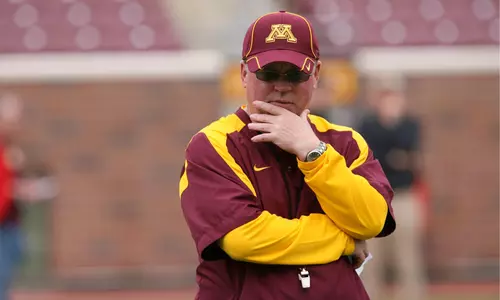
Kill: Looking Forward to Monday
8/4/2011 12:00:00 AM | Football
Aug. 4, 2011
The following is a transcript of Minnesota Head Football Coach Jerry Kill's pre-camp press conference, held Thursday at the Gibson-Nagurski Football Complex. The Gophers open camp Monday in preparation for the 2011 season, which opens Sept. 3 at the University of Southern California.
Jerry Kill: We appreciate everybody being here today and thank you for coming out on a busy day today. I'm happy to see everyone and I'd say that the best thing I can give is a big speech. That's about all I've done all summer long is talk and visit and so forth. We're excited about the opportunity that will be coming upon us Monday, getting out on the field and throwing them out there and seeing what we have. It's been a long time since the spring, and now we're going into fall camp and we'll see how much work and progress we've made. We'll have some new young people that we haven't seen. We'll have the opportunity to see them and kind of see where our football team is. That's kind of where we're at--looking forward to it. And I'll take any questions that you all have.
Question: Going into Monday, what do you have? What do you know you have?
Kill: Going into Monday, we know we have a team that's got to get a lot better than what they did from the spring. Did they put the work in this summer? Did they do what they needed to do in the weight room? Did they do what they needed to do conditioning-wise? Have they become better? I challenged them at the end of the spring that they had to be a lot better than what they were at the end of the spring. Hopefully, they've done their work. We'll know a lot more about that when we get to work with them throughout two-a-day camp.
Question: Are you confident that they did that work in the summer?
Kill: We'll see. I always say... until you're out there physically with them and you watch them and you work with them, that's a question that I can't answer, but I think the kids... Summer school finished up today. It's just like anything. It's no different than--the Vikings are in camp right now. They don't know exactly what they have until they get out there and work with them. We're no different?
Question: Have you set up your camp schedule so that you know almost immediately if they've been doing the work this summer? How have you designed the camp?
Kill: I had camp designed a long time ago, had practice schedules done. We just met today making sure everybody was on the same page. We got scripts done. We're ready to go. Everyday's a process, just like any job or any company runs. Each day's a process of an evaluation for us. You'll know pretty quick. You go three huddles on the first day, you'll find out who's done their work.
Question: Do you have any concern that any lack of depth will keep you from practicing as fast as you'd like to?
Kill: Well, you have to adjust with what you have. You're going to have injuries. You can't treat every player the same. You can't treat every team the same. Each team is different from year to year, and so we'll take what we have and we'll work with that group of youngsters to see what direction we need to take. If we have to cut down on some of the things we've done in the past, that's what we'll do. We're not going to try to make somebody do something that they can't do (or) we're not going to be very successful. So we need to find out what this group can do, and then we have to adjust a little bit. Do I like having to adjust a lot? No, but it is what it is. That's called coaching. So we'll have to work with what we have, and if we have a lack of depth in some areas, then we'll have to be careful in those areas.
Question: What will constitute a successful season?
Kill: We get better every day. I think everybody wants to put wins and losses and things of that nature, but where we're at in our program right now, we're starting from the ground up to where we need from an academic standpoint, from an APR standpoint, from an investment standpoint. We have work to do, so we've just got to better every day. It's no different, again--I talked to 365 business people a couple days ago--it's no different than buying a company that's not been very successful and you've got to find a way to fix it. You evaluate how you're going to fix it, then you go try to fix it. That's what we're doing. We identified there's much more than just the football players themselves--it's the whole program. We've analyzed it, we've got a vision, and now we've got to go work. That's what we're doing. ...I will tell you right now, we're better than what we were when we came in. That's a credit to the kids, not me. That's a credit to the kids and the other people around the program. But we're better. We've done better in a lot of areas. We had a 2.87 GPA last semester. That's better. Is it where it needs to be? We need to keep getting better, but I just want to see us getting better from week to week. We have the same goal as everybody else does. I mean, you don't get into business and not compete. I'm a competitive guy. You want to do all those goals, those pyramids and goals, and we have plenty of them. We'll talk about them on the first day. Here's the ultimate goal. Every team that starts in the NFL wants to win the Super Bowl. Every team that plays college football wants to win the national championship. I worry about the steps to get there. ...We wrote on the board about 10, 12 things that we have to do. You'll ask me. I can't remember everything off the top of my head right now, but 10 or 12 things that we have to do to bring our program in a direction that we need to take. We're going to concentrate on those. If we get better at those, we'll win our share of games or whatever. If we don't, I can go back to those 10 or 12 things and say, `Well, we haven't captured them yet.' One of those is just playing hard. Another one of those is no distractions. We can't have a bunch of distractions off the field, on the field, all that crap. We can't win doing that. That's two things right there off the top of my head. No academic casualties. There's three. I could keep going. But if we do those by-products, then we'll reach those other goals. That's what I've told every team I've coached--I've been a head coach for 17 years--is that, `Here's what we want. We wanted to see what you could do, but this is how you get there. We've got to work more about how we get there.'
Question: Are you limited to the number of kids that can come in Monday? Do some of them have to wait until school starts?
Kill: Yes, sir. You can bring 105 players in. We have Sunday orientation, but we still have practice on Monday.
Question: Coach, is there anything that you've been thinking about over the spring and waiting to see about your team, something in your head that maybe--`Boy, I can't just wait to see if we can do this or that.'?
Kill: We have worked hard all summer long, I mean everybody. To be honest with you--once I get done here, I've got to go speak at something else. I need about 24 hours by myself, walking the Mississippi, whatever I can find, to get away from it a little bit, because I've got to get re-juiced because we've been going hard. I think the biggest exciting thing that I have, that we're looking forward to, is going back out on the field. It isn't about schemes. It's about if we've gotten a little bit stronger, a little bit faster. Some of the new recruits that are in, you're always looking forward. Are they really as good as you anticipated, or are they not quite where they need to be? Those things always excite you. We're all on the same page now. We're all going to practice the first practice. Who's going to win that first practice, so to speak? Who's going to do the best job getting better. Again, I can't really worry about all the other teams. We've got to worry about what we can control here. We have to take our kids, and we can't worry about USC and New Mexico State, all those things. We need to worry about is, we control who we are. We've got to get better, and that's what we'll focus on.
Question: Is every position open, or do any guys carry over from the starters?
Kill: You're all smart. There are some places you'll look at and say, `It's going to be hard to beat this guy,' because there's not a lot of competition. Other places, there's competition. I don't get into what's open, what's not. We're going to put the best damn player on the field. That's what our job is. If all of a sudden we've got somebody come in that's the best player, we're going to play him. If we've got somebody that's not performing and we've got somebody that's going to perform better, we're going to play him. This isn't intramurals. It's college football. I'm into competition every day. If we've got somebody that can't get the job done over the next three weeks and maybe has been playing... Nobody's entitled to anything in life. You earn it. So we'll see. Are there some people farther along who know more about the position, and things of that nature? Yeah. And some work hard and do what they're supposed to, and so forth, and they're a great talent. You've got to figure that sometimes the competition is within yourself. A guy like MarQueis (Gray), some of the competition's within himself. How good can he be? It's about the individual being the best he can be. So to me, you always have competition. If we can get every player that we have to give their best of their ability and play as hard as they can play, then we'd solve a lot of problems quickly. But that's not easy to do in this day's culture. But nobody's entitled to anything. We've got to work for it.
Question: How do you feel about MarQueis's added weight, strength--he's up to 240-plus now.
Kill: When I see him, when we get out there and work, I'll see if that's good or bad, when I see him out there moving around and throwing and see how much better player he's made. I know he's done a good job in his class work and those kinds of things. I know that he's worked hard at trying to be a leader and things of that nature. I think when you come out in spring, I think he was focused on being better. I've certainly talked to him and said, `Hey, if you want to be good, these are the things you've got to do.' Again, we'll get to find out quickly what his progress is, physically. I know our strength coach is excited and feels like we made some strides and those kinds of things. But again, what you do in there, that gives you an opportunity, but it doesn't guarantee you success. You've still got to translate the weight room over to the football field. I've see a lot of guys lift a lot of weights but can't play football. I've seen guys that are 10.4 track guys that can't play football. You've got to translate that to the football field. Hopefully our guys can do all that. I think the big thing in strength training in summer, to be honest with you, is more about staying healthy than it is anything. Football's a grind. We're going to start, and it's a grind. You go into Big 10, and also playing USC and the rest of those people--it's a grind. So you physically and mentally better be on top of your game. That's more what the strength training's about more than anything--so you can hold up, so to speak, through the long season.
Question: Coach, with the Vikings that came up in terms of the size of their offensive linemen. They cut one loose because he was too big. What's your theory on that...What do you think an offensive lineman should look like?
Kill: Well, I think each person...Sometimes there's just big people. There are some people that are 350 pounds that can move like gazelles. I think it's the body structure you have and the weight that you're at--can you play and perform at the level whatever your body weight is. You look back through the Cowboys, and some of those guys were huge. But they were athletically huge. So I think it goes back to what a person can carry. I'm no different than anybody else, and certainly like the Vikings, you're concerned about health factors. You've got to put that into account. If you practice out in the heat and you're 360 pounds or 350 or whatever it is, and your body's not used to that or can't perform at the level you have to perform at, then it hurts you. There's what I call--you've heard me say--athletic freaks. There are some people that can carry 330 pounds, and they're unbelievable athletes, but they're not very many that can be that heavy. So you're really concerned. ...You're concerned for those people playing the game because, again, as coaches we're accountable for a lot of things. You certainly don't want somebody to drop down on your time watch because they're not physically ready to play the game.
Question: With two returning starters on that offensive line, is that kind of the key, is to get that sorted out?
Kill: I think that key for us is not just offensive line. I think it's, again--we're new people--I think it's our whole team. Having two offensive linemen that have played, that's great. We've got to find out who the other three are, and we've got a lot of young freshmen and things of that nature. But I think, as far as our whole football team, I think we've got to identify that cohesiveness. We've got a big job ahead of us. In one month, we've got to get a group of guys, and new people, and we've got to bring them all together and we've got to get ready to play. The NFL is finding that out right now. Like I said before, we have a unique football culture. Jim Delaney said it to us as coaches as he met with us, he says, `You guys are the 12 coaches here in the Big 10, and whether you like it or not, you represent the Big 10, and you're the CEO of football. And there's a lot of money made in football, so you're responsible for all of these areas.' He was talking about some of the problems that we have in college football, and I got to thinking about that. That's true. But what's unique about what we do in the football culture is that we're allowed to spend only 20 hours or whatever it is--I spent more time coaching at Webb City. In high school you spend more time with the players than you do in college, and yet with the hours that you're regulated to and the emphasis on the classroom and APRs and GPAs and all that, and then those kids go out and play in front of 100,000 people--it's not like the business world where you get them 45, 50, 60 hours. So it's kind of a unique deal. It really is. But we're responsible for getting them ready, and the NFL's kind of in that thing right now. They haven't had all these preparations. I think the NFL's--you'd have to ask them--probably more worried about the conditioning and the shape because they didn't have all those mandatory workouts, etc. Our guys were here this summer, they went to summer school. I'm not worried about the shape of them. I think that what we have to do is, we hope Eric's (Klein) done his job so when we get them Monday, we can teach and get better and get ready to play and find out who those players are going to be and where they're going to be at.
Question: You mentioned a little bit about the backup quarterback spot. You want to have someone to push MarQueis this fall. There are probably four guys--(Max) Shortell, (Moses) Alipate, (Tom) Parish, and a new kid, (Dexter) Foreman--who are probably in that mix, do you think?
Kill: Yeah. We'll just have to figure out who that's all going to be...put their work in, who picks up the system and who can learn and who we feel like we can trust on a day-to-day basis. ...Quarterback's a different position. That's why everybody--they'll draft one and they take a veteran. It's a unique position. But we do have to find some depth there. There's no question about that. No question.
Question: You mentioned in the spring that you might be changing some positions for players. Have you decided to do any of that?
Kill: I'm trying to think here--(Gabe) Mezzenga's talked to me about maybe moving to tight end. J.D. Pride's going to stay at wide receiver. A couple things there, but nothing drastic. The big thing's trying to find out where the freshmen fit in and things of that nature. That's always a challenge going into camp. The way we'll practice is...we'll have two huddles going on one field. We'll have another group going. We'll have three huddles--three offenses and three defenses all going at the same time somewhere. (We'll have) video of it all. That way we get everybody repetitions so we give everybody a fair evaluation. Then we try to put the ones that are consistent and ready to play on the field. Part of that `ready to play' is, too, is how they can handle the classroom and football at the same time. That's the toughest thing for freshmen. Can they really do that? Marcus Jones is around. He came in a semester, is a 3.8 GPA or something like that, 3.7. And to be able to go to college in the middle of it and play football, he's a pretty special kid. Not many are like that. Marcus will be ready to play.
Question: How do you decide who gets to start camp on Monday?
Kill: That's why they pay the big bucks to the coach. There's a lot of things that go into all that--evaluations with depth and positions. We had so many injuries at receiver. Are we going to bring in a couple extra receivers, so maybe we don't bring in a couple linemen? It's nothing to do with the kids, so to speak. It's what you need on the football team at that particular time or what you need to see. We had trouble at receiver because of injuries and lack of experience and so forth. We're going to try to secure that up a little bit if we can.
Question: Would that be primarily walk-on kids who wouldn't be able to start until school, or could that be anybody?
Kill: It could be anybody.
Question: When's the next week guys can come in? Is it the first day of school?
Kill: Yeah, or you can do it if--let's say a young person gets hurt in the second week of practice and is out for a month or two, then you can bring somebody in to replace him. It's a little bit unusual because we don't start school before we play. It's usually the first day of school, so usually you go through camp for about two and a half, three weeks. Somebody leaves camp and then when school starts, you can put one back in. But in our deal, we've got a month before school starts, so if we lose somebody out of camp, they can't play in the USC game if you replace them. So we'll have to be careful with what we're doing with the replacing deal. We're not that deep, so we'll be on the other side of it, worrying about if we have enough guys to do what we need to do.
Question: You've had a lot of discussions with people about the program, including former coaches. What's maybe the biggest thing you've learned from some of those discussions about what's gone on before you got here?
Kill: I don't have time enough. That would be another press conference, if I listed all the opinions I've gotten. I've gotten a lot of opinions.
Question: What about from the coaches specifically, maybe?
Kill: I talked to a lot of them, too. I think Coach (Lou) Holtz told me the best thing. He goes, `Coach, you know what you're doing. Do it your way. You know what you're doing. You don't change what you do.' I think that he's watched us from the outside where I've been before. I think every coach has his take on, `If I'd come back, I'd do this a little bit different.' But I think most coaches are going to tell you...it's about the investment in the program. It's from the players, coaches, financially. But investment in the program. I think every coach that comes into something says that. There's truth to that, and that's what we're working on. That's my job. That's why they hired me. It's my job to sell everybody and teach everybody what it's going to take to win, and that's from our players to administration to you all to the state of Minnesota. I've got a vision and I'm going to stick to it. I'm a pretty persistent human being and I'm going to stay persistent. I'm not going to give in, and if it doesn't work out, I guess I'll be polishing somebody's shoes in here or whatever, but that's okay. I definitely know the direction we need to go, and we're going to stay on that path. There will be good times and bad times. ...I've been through a 1-10 season, and two years later 10-2 and won 50-some-odd football games. That was the worst year of my life, that 1-10 season, but it's probably the best coaching job we ever did. You can't worry about all that. ...There's no quick fix in life. This is not a quick fix thing. This is not a deal where, `Hey, let's win immediately. Let's quick fix it and get the hell out of there.' I want to be here, and I want to build a program. Everywhere I've left they've won. I want to continue that. It's about building a program and doing it right. We're going to do it right. I may get hit in the head the first few years, one year, or three years, I don't know. But I'm not going to bend off what works. I know it works. Usually what happens when stuff hits the fan, people bend off what their plan is, and then that's when they get in trouble. You've got to stay with what you believe in, and if you do that through the tough times--I always say you judge people when their back's against the wall. Anybody can do anything when everything's going right. You judge a person when their back's completely against the wall. Mine's been back against the wall a few times, not only in personal life, but also in football life, so I've got pretty thick skin.
Question: Can you talk about the wide receiver depth? How is Da'Jon (McKnight) and just the development of the wide receiver corps in total--how is important is it to MarQueis's development?
Kill: It's huge. That's something when we come out here in fall camp that's huge. We've got to stay healthy in that position. We've got to be careful with Da'Jon and his repetition, because he is coming off the knee situation and we need to cut his reps down. There is no question about that. We need him to be ready. We'll know a lot more about that. We've got to be careful with that position. We've got to work him hard enough to get better, but we can't have him run down to where he can't perform. And there's a fine line in there. Spring ball is a little bit different than two-a-day camp. Everything changes a little bit. But we've got to get quality reps. That's the big thing.
-UM-