by Shelby Kieffer, Athletic Communication Student Assistant
The old adage is that absence makes the heart grow fonder. Minnesota redshirt junior Gadiva Hubbard can attest to this.
Hubbard, who had started 43 games in her first two years on campus, was coming off a 2017-18 campaign where she ranked 10th in Minnesota history for 3-pointers made in a season (69) and put up eight 20-point games for a team that advanced to the second round of the NCAA tournament.
However, in October of 2018, she had surgery on her right foot. She elected to have the procedure to speed up the healing process, but having her out of the lineup was a notable loss for the team, especially as head coach Lindsay Whalen embarked on her first season at her alma mater.
"We were just starting to get to the point where we were going to start getting the first team and rotations down when she got hurt," Whalen said at the time.
As difficult as it was for Whalen and the staff to fill Hubbard's spot, it was just as tough for Hubbard as she adjusted to her new reality.
"It was very hard mentally," Hubbard said. "It was really hard to watch my team go out there and play and I couldn't contribute in any way."
During this time, Hubbard dedicated herself to cheering her teammates on while undergoing intensive physical therapy. Her teammates were there for her equally in return.
"I'd always have weights or conditioning outside of the team, so I could get what I needed," she said. "They would always volunteer to do it with me."
The Virginia Beach, Va., native also noted how assistant coach Carly Thibault-DuDonis shared her own foot injury story that made Hubbard feel less alone.
"She told me about an injury she had in her foot and I was like 'wow, I'm not the only one, ok, I feel a little better,'" Hubbard recalled.
Thibault also worked out with Hubbard which further encouraged her.
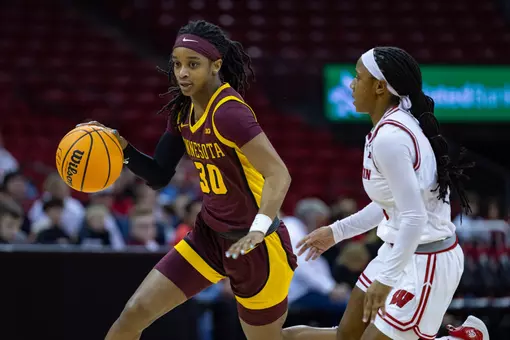
"I like working out with people, it's fun," Hubbard said. "It makes me feel like I'm not the only one who goes through stuff like this because I feel like throughout my career there has always been something going on with me, always." Gadiva Hubbard is second on the team this year in scoring at 12.4 points per game.
Hubbard took advantage of the time she was sidelined to learn more about the game. She watched and learned as Whalen and her staff began to build new systems at the beginning of their tenure. She also had the opportunity to observe other teams' gameplans and strategies.
"I would think of different moves I could do while watching games and practices," she explained. "I was able to talk to my position teammates and tell them what they could do and it helped in practices so I think it translated to games."
This study of the game only intensified Hubbard's wish to return to the court, but the rehabilitation process still needed more time.
"It was very slow in my eyes because I just wanted to jump back into practice," she said. "I think after a certain amount of months I was only able to do a very few things."
Hubbard noted that in the beginning of her rehab process that lateral movements were the most difficult and caused the most pain early on.
All the long hours and hard work paid off for Hubbard, though, as she made her return to Williams Arena for the 2019-20 season opener against Missouri State. She played 20 minutes and scored two points. Later she spoke of the nerves she experienced before that game.
"I was very excited, but also very nervous," she said upon reflection of her return. "I think those nerves got to me the first game, so I wasn't able to do what I usually do."
So when Hubbard put up 20 points and four 3-pointers against Arizona State on Nov. 17, the fourth game of the year, it felt like a return to normal.
"I was like 'yeah, I think I'm good now. I think I'm back.' I've just been trying to build off of that game," she said.
That momentum has continued to build on the court. Since her return, she has averaged 12.4 points per game, 2.9 rebounds and .361 percentage from the three-point line. Hubbard also leads the Gophers with 38 steals this season.
Beyond that, the upperclassman has taken what she learned while sidelined last year and grown in her role as a player and teammate.
"I think I've become more of a leader because I can show what to do or how to do something," she said.
"I now treat my practices and games like it could very well be my last. You can learn to come in and get extra work in. It's cliche, but you learn to not take the game for granted."