
University of Minnesota Athletics


Players Mentioned

Forward
/ Men's Basketball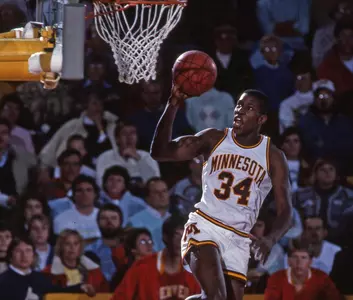
Burton Gets His Banner
1/24/2020 9:09:00 AM | Men's Basketball
This feature will run in Sunday's game program as Gopher legend Willie Burton has a banner raised in his honor during halftime of the Michigan State game. Interview by Matt Little, Athletic Communications Student Assistant
Gopher Sports: Talk about what this banner means to you, or what it means to you to be honored here tonight.
Burton: From my perspective, I think this not only honors me, but it also honors the University. It honors the staff members that participated and assisted me in reaching that goal, the professors that kept their foot on my neck while I was there, my teammates, and the athletic department. It's a combination. It's real easy to see the finished product; however, this is a combination and an opportunity for Minnesota Athletics to be recognized.
GS: Looking back on your time here at the 'U', what's one memory that sticks out to you the most?
Burton: I actually have two. The first was when I walked into Williams Arena during my visit. The first thing I noticed was the Hall of Fame, all the retired jerseys up there in the rafters. At the time that I came to school, those were the only banners in the arena, so they stood out. There weren't any NCAA or Big Ten banners, it was only the individuals that had their numbers retired. They stood out, and I thought "Wow. It would be great to be one of those individuals one day and have the opportunity." The second memory was the game against Iowa in January of 1989. That's when our team turned the corner and we saw our path to the Sweet Sixteen and Elite Eight. I think those are two memories I have that will always stick out.
GS: What about the 'U' attracted you, instead of somewhere a little closer to home in Michigan?
Burton: Well, I never had a goal to play in the NBA. I was fortunate to have supportive families, and to be put in the educational system that focused on education first. I came to the Twin Cities when my four years were over to live because the Twin Cities had everything I ever dreamed of in a city from my perspective. It was a little cold, but I could get over that with all the other pluses it had. It had excellent education and friendly people, it was large with Minneapolis and St. Paul, and it was somewhere I felt that, when I finished my time at the University, I could fill in like all the others had done before me. They were all there. They were high level executives in companies and corporations, and I really respected that and that was something I did not see in my visits to other universities. It felt like somewhere I could make home.
GS: If you hadn't played basketball, did you have any other sports you would've liked to play or sports you were really good at?
Burton: I was really good at baseball. As a matter of fact, I had to quit baseball my junior year of high school because I needed to go to camps and other things. So baseball actually was my first sport.
GS: What was it like for you watching Jordan Murphy pass you as second on the all-time scoring list last year?
Burton: Records are meant to be broken. My NBA record was also broken last year by James Harden (Points in a game vs. Heat (58)). They serve as benchmarks, similar to myself walking in Williams Arena and seeing those retired jerseys. They are to serve as a benchmark to give players an opportunity to achieve things that they never dreamed of. That's what I see it as. Congratulations to him, I'm very happy for him. For that record to last for 28 years, that in itself is really special. But on top of that, look at his rebounding! That's even more phenomenal. He had a phenomenal career at Minnesota, one that will be talked about for ages.
GS: Is there anyone on last year or this year's roster that you think would have a chance to beat you one-on-one in your prime?
Burton: Oturu is one heck of a player, you just see it. A great player stands out, and Oturu is standing out as the next great Gopher from my perspective and it's clear. It's not just clear to me, it's clear across the United States.
GS: Do you think he could've taken you, or do you think you still would've got him?
Burton: The fact that we play different positions, he'd have an advantage inside, and I'd have an advantage outside. That's the way I look at that, but when I look at players, I look at them on their ability to perform and the level they perform at. Not taking anything away from Amir or Jordan at all, but Oturu, in my personal opinion, is just the type of player that played the way I played. The dominance at any level against anyone. His approach to the game, and his domination of the game is what I see, and that's what I respect. Because hell, we can all have talent and we can all do certain things, but to dominate a game on the road and at home the way he's doing is phenomenal.
GS: Did you have any signature moves, or moves that when you did them, you were pretty sure or almost certain it was going to go in?
Burton: Well, my approach to the game of basketball was you either give me the jump shot, or I'm going by you. It's like pick your poison. You had to play me from the three-point line, but when you did, I was able to go around you. I guess a better question would be, "What was my biggest strength?" My biggest strength was my ability to take advantage of opportunity. Again, this goes into what I talked about earlier. Someone had to set the screen for me and someone had to pass me the ball, so my team was just as big a part of me going up [in the rafters] as anything. It's "Willie Burton, #34", but they're going up with me. My teammates took the flak a lot of the time for me breaking plays also. Sometimes, I would break plays in order to get things done, and my teammates would cover for me. If Coach Haskins is ever interviewed, to this day he'll tell you this happened: Coach Haskins calls the play in the huddle, and I, understanding how the game is working, know that play's not going to work. So, I'll go pull Melvin Newbern aside and say "this is what we're going to do," and I'd change the play. I didn't do it a lot, I just did it at crucial times of the game when things needed to happen, and I had to make sure that it worked because if it didn't, coach was going to take my head off my shoulders when we got to the sideline. Here's the thing about that though, Coach Haskins knew that I was breaking the play. After the play break, he would watch me go talk to Melvin, and he knew I was breaking the play. He told me he would act like he didn't hear anything, but I guarantee you this, he was going to skin me alive when I got back to the bench if it didn't work.
GS: Who was your favorite athlete you watched or admired growing up?
Burton: My favorite athlete probably was Terry Cummings. That's why I wear number 34. He dominated the game. He literally dominated the game inside and out.
GS: What have you been up to since finishing your degree?
Burton: I'm in Detroit with the public school system. I'm finishing my masters in sports administration, and I have one more course to go until I finish. I've been writing curriculums, creating policies, and improving school programs and education. I have three areas of focus with that. First, I have safety. I helped launch the Project Safe Campus program from 10 schools in Detroit to 400 schools in eight different counties. Second is interscholastic athletics, and third is life skills. I have a program we're about to release nationally with Starr Commonwealth for student athletes across the United States and internationally. That program was actually created at the University of Minnesota, it's called Excel U.
GS: Do you have a dream of what you want all the work you're doing right now to achieve?
Burton: Yes, I'm glad you asked that question. While finishing my degree at the University of Minnesota, I walked by this area called the "Walk of Fame." It's where all the names of the former university students who have done very honorable things, like saving lives through cancer and many other things are displayed. When I saw it, I thought about it and set a goal for myself to work with an underserved population called the student athlete. There are millions of us that aren't receiving what we should, as far as our preparation for our roles and responsibilities, and what's expected of us before coming to college. That's one of the reasons that I work at the level that I do of interscholastic. I've worked with collegiate and professional players as well, so I've worked at all three levels, and what I found was that most of the problems and issues occur at the early stages of life, and they're never dealt with. What happens is, they transfer into adults never having been dealt with, then things happen in a highly visible environment. In most cases, if there were issues all the way along here from either second grade to a senior in highschool, they could have been talked about and dealt with prior to sending them to a college campus. About 50% of student athletes are not in school or with the same school they started with their junior year of college, so how can we cut this number down? Why is it happening? Well, it's happening for a number of reasons, and preparation will help those. The great thing about this program is that I did it in conjunction with the University of Minnesota, so the University of Minnesota measurements department and athletics department were part of helping me discover this information.
GS: Is there anything we didn't discuss you'd like included?
Burton: No, not really. I think the one thing I want included is that Willie Burton didn't do this by himself. That's the most important thing because the individuals in the staff, coaches, and teammates are how this happens. I could go on for days on how important everyone else was.
FAVORITES:
Color: Maroon and Gold
Music Artist: Jonathan Butler
Place on Campus: Big 10 Restaurant & Bar
Breakfast Food: Banana Nut Pancakes
TV Show or Netflix Series: National Geographic
Animal: Dog
Dessert: Brownie Overload with the Ice Cream, Nuts, etc.
Gopher Sports: Talk about what this banner means to you, or what it means to you to be honored here tonight.
Burton: From my perspective, I think this not only honors me, but it also honors the University. It honors the staff members that participated and assisted me in reaching that goal, the professors that kept their foot on my neck while I was there, my teammates, and the athletic department. It's a combination. It's real easy to see the finished product; however, this is a combination and an opportunity for Minnesota Athletics to be recognized.
GS: Looking back on your time here at the 'U', what's one memory that sticks out to you the most?
Burton: I actually have two. The first was when I walked into Williams Arena during my visit. The first thing I noticed was the Hall of Fame, all the retired jerseys up there in the rafters. At the time that I came to school, those were the only banners in the arena, so they stood out. There weren't any NCAA or Big Ten banners, it was only the individuals that had their numbers retired. They stood out, and I thought "Wow. It would be great to be one of those individuals one day and have the opportunity." The second memory was the game against Iowa in January of 1989. That's when our team turned the corner and we saw our path to the Sweet Sixteen and Elite Eight. I think those are two memories I have that will always stick out.
GS: What about the 'U' attracted you, instead of somewhere a little closer to home in Michigan?
Burton: Well, I never had a goal to play in the NBA. I was fortunate to have supportive families, and to be put in the educational system that focused on education first. I came to the Twin Cities when my four years were over to live because the Twin Cities had everything I ever dreamed of in a city from my perspective. It was a little cold, but I could get over that with all the other pluses it had. It had excellent education and friendly people, it was large with Minneapolis and St. Paul, and it was somewhere I felt that, when I finished my time at the University, I could fill in like all the others had done before me. They were all there. They were high level executives in companies and corporations, and I really respected that and that was something I did not see in my visits to other universities. It felt like somewhere I could make home.
GS: If you hadn't played basketball, did you have any other sports you would've liked to play or sports you were really good at?
Burton: I was really good at baseball. As a matter of fact, I had to quit baseball my junior year of high school because I needed to go to camps and other things. So baseball actually was my first sport.
GS: What was it like for you watching Jordan Murphy pass you as second on the all-time scoring list last year?
Burton: Records are meant to be broken. My NBA record was also broken last year by James Harden (Points in a game vs. Heat (58)). They serve as benchmarks, similar to myself walking in Williams Arena and seeing those retired jerseys. They are to serve as a benchmark to give players an opportunity to achieve things that they never dreamed of. That's what I see it as. Congratulations to him, I'm very happy for him. For that record to last for 28 years, that in itself is really special. But on top of that, look at his rebounding! That's even more phenomenal. He had a phenomenal career at Minnesota, one that will be talked about for ages.
GS: Is there anyone on last year or this year's roster that you think would have a chance to beat you one-on-one in your prime?
Burton: Oturu is one heck of a player, you just see it. A great player stands out, and Oturu is standing out as the next great Gopher from my perspective and it's clear. It's not just clear to me, it's clear across the United States.
GS: Do you think he could've taken you, or do you think you still would've got him?
Burton: The fact that we play different positions, he'd have an advantage inside, and I'd have an advantage outside. That's the way I look at that, but when I look at players, I look at them on their ability to perform and the level they perform at. Not taking anything away from Amir or Jordan at all, but Oturu, in my personal opinion, is just the type of player that played the way I played. The dominance at any level against anyone. His approach to the game, and his domination of the game is what I see, and that's what I respect. Because hell, we can all have talent and we can all do certain things, but to dominate a game on the road and at home the way he's doing is phenomenal.
GS: Did you have any signature moves, or moves that when you did them, you were pretty sure or almost certain it was going to go in?
Burton: Well, my approach to the game of basketball was you either give me the jump shot, or I'm going by you. It's like pick your poison. You had to play me from the three-point line, but when you did, I was able to go around you. I guess a better question would be, "What was my biggest strength?" My biggest strength was my ability to take advantage of opportunity. Again, this goes into what I talked about earlier. Someone had to set the screen for me and someone had to pass me the ball, so my team was just as big a part of me going up [in the rafters] as anything. It's "Willie Burton, #34", but they're going up with me. My teammates took the flak a lot of the time for me breaking plays also. Sometimes, I would break plays in order to get things done, and my teammates would cover for me. If Coach Haskins is ever interviewed, to this day he'll tell you this happened: Coach Haskins calls the play in the huddle, and I, understanding how the game is working, know that play's not going to work. So, I'll go pull Melvin Newbern aside and say "this is what we're going to do," and I'd change the play. I didn't do it a lot, I just did it at crucial times of the game when things needed to happen, and I had to make sure that it worked because if it didn't, coach was going to take my head off my shoulders when we got to the sideline. Here's the thing about that though, Coach Haskins knew that I was breaking the play. After the play break, he would watch me go talk to Melvin, and he knew I was breaking the play. He told me he would act like he didn't hear anything, but I guarantee you this, he was going to skin me alive when I got back to the bench if it didn't work.
GS: Who was your favorite athlete you watched or admired growing up?
Burton: My favorite athlete probably was Terry Cummings. That's why I wear number 34. He dominated the game. He literally dominated the game inside and out.
GS: What have you been up to since finishing your degree?
Burton: I'm in Detroit with the public school system. I'm finishing my masters in sports administration, and I have one more course to go until I finish. I've been writing curriculums, creating policies, and improving school programs and education. I have three areas of focus with that. First, I have safety. I helped launch the Project Safe Campus program from 10 schools in Detroit to 400 schools in eight different counties. Second is interscholastic athletics, and third is life skills. I have a program we're about to release nationally with Starr Commonwealth for student athletes across the United States and internationally. That program was actually created at the University of Minnesota, it's called Excel U.
GS: Do you have a dream of what you want all the work you're doing right now to achieve?
Burton: Yes, I'm glad you asked that question. While finishing my degree at the University of Minnesota, I walked by this area called the "Walk of Fame." It's where all the names of the former university students who have done very honorable things, like saving lives through cancer and many other things are displayed. When I saw it, I thought about it and set a goal for myself to work with an underserved population called the student athlete. There are millions of us that aren't receiving what we should, as far as our preparation for our roles and responsibilities, and what's expected of us before coming to college. That's one of the reasons that I work at the level that I do of interscholastic. I've worked with collegiate and professional players as well, so I've worked at all three levels, and what I found was that most of the problems and issues occur at the early stages of life, and they're never dealt with. What happens is, they transfer into adults never having been dealt with, then things happen in a highly visible environment. In most cases, if there were issues all the way along here from either second grade to a senior in highschool, they could have been talked about and dealt with prior to sending them to a college campus. About 50% of student athletes are not in school or with the same school they started with their junior year of college, so how can we cut this number down? Why is it happening? Well, it's happening for a number of reasons, and preparation will help those. The great thing about this program is that I did it in conjunction with the University of Minnesota, so the University of Minnesota measurements department and athletics department were part of helping me discover this information.
GS: Is there anything we didn't discuss you'd like included?
Burton: No, not really. I think the one thing I want included is that Willie Burton didn't do this by himself. That's the most important thing because the individuals in the staff, coaches, and teammates are how this happens. I could go on for days on how important everyone else was.
FAVORITES:
Color: Maroon and Gold
Music Artist: Jonathan Butler
Place on Campus: Big 10 Restaurant & Bar
Breakfast Food: Banana Nut Pancakes
TV Show or Netflix Series: National Geographic
Animal: Dog
Dessert: Brownie Overload with the Ice Cream, Nuts, etc.
Friday, June 12
Thursday, April 02
Monday, March 30
Wednesday, March 11