University of Minnesota Athletics
Gabe's Race of Courage
4/21/2010 12:00:00 AM | Women's Track & Field
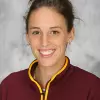
On April 11, 2009, Gabriele Anderson ran her personal best time (4:22.87) in the 1,500-meter race at Arizona State’s Sun Angel Classic. On April 10, 2010, Anderson ran a new career best of 4:20.56—the fifth best time in Gopher history—at that same meet. At first glance, these look like normal track results—a runner improving on her time from one season to the next. But in Gabriele Anderson’s case, there is so much more to the story than a difference of 2.31 seconds.
Anderson was a great prep athlete, winning a state title in the 800-meter race her senior year and earning all-state honors in cross country four times at Perham High School. The University of Minnesota recruited her, but her decision to join the team came late in the recruiting season.
“I stopped recruiting her sometime in the middle of her senior year because I could never get a commitment out of her,” said Gophers head cross country coach and assistant track coach Gary Wilson. “Finally in May, she walked through that door, and I went, ‘Okay. This kid is going to be good.’ You could just tell. She had that presence about her, and I think that’s the key word.”
As Wilson predicted, Anderson has been good. She has competed at the NCAA Championships in cross country three times, and in indoor track twice. She has earned second team All-Big Ten honors five times.
Last season, she was the Big Ten runner-up in the mile during the indoor season, and competed at NCAAs. The outdoor season was shaping up to be a positive conclusion to Anderson’s career—until things changed in April.
Anderson had noticed a lump in her neck and saw several doctors before having a biopsy in early April. The day before the Sun Angel Classic, she found out that she had adenoid cystic carcinoma, a rare cancer of the salivary gland.
“It’s a very surreal experience for anyone, something that you especially don’t expect at my age—you tend to take your health for granted a little bit,” said Anderson.
Because of the gravity of the diagnosis, Anderson’s coaches told her she didn’t have to race the next day. But Anderson declined to sit out, assuming that this would be not only her last race of the season but possibly of her career, and ended up posting her career best time in the 1,500. Six days after her diagnosis, Anderson underwent a surgery that took over five hours.
“I had a hard time recovering from the surgery in the hospital,” she said. “It definitely took me awhile to recover in general. That was hard for me.”
Anderson did go back to school and finish the semester, but she had to take a break from running. Wilson and head coach Matt Bingle got permission to bring her along to the Big Ten Championships in May. She had mixed feelings about this, saying that it “was cool, but it was bittersweet because I obviously imagined myself competing at the meet rather than watching.”
Anderson underwent radiation treatment from late May to mid-July. Her doctors told her that she could start running around four weeks after she was done with radiation. In August, she started running a few days a week for short periods of time. At the beginning of the school year, she had worked her way up to running five or six times a week.
“It was definitely a slow start, she said. “That was kind of hard for me at first because I haven’t been that out of shape in a long time. So I was a little afraid of thinking about returning to the track. After a few months of getting some base down and getting back into running, I started to feel better again.”
Training was even harder due to the fact that she didn’t know if it was going to pay off. Anderson had begun thinking about a sixth year of eligibility almost immediately after her fifth season ended, not wanting her career to end with a cancer diagnosis.
“I wanted to know that there was a possibility that I could return and could finish on a different note,” she said. “After five years of doing this, you imagine your career ending much more positively.”
Anderson knew right away that she wanted another chance to compete, but it took months to find out if that extra season would become a reality. She made her case to the NCAA, and then waited and trained, not knowing for sure what the decision would be.
“I was definitely worried,” she said. “I wasn’t too familiar with the application process for how the clock extension worked. I thought that I would have a pretty good case, but it took awhile. I kind of put other things on hold to start training…In order to get prepared for this season, it required me to be committed to it a few months before I even knew that I was going to have the season.”
When the phone call finally came in December, Anderson—who admits she is normally slow to return voice mails—quickly returned Coach Wilson’s message. She then learned that the NCAA had granted her another season of eligibility.
“He said he had good news, so I was like, ‘OK, I should probably call him back,’’ she said. “I had a hunch that it was about my eligibility because we were kind of expecting to hear…It would have been really devastating for me to not have gotten it. That was always in the back of my mind that it might not happen. When I finally found out, it was really special and I was really excited.”
Wilson was pleased with the news, too.
“It was pretty emotional,” he said. “I always thought that she would (get an extension)…She was just thrilled because she really wasn’t sure. I was thinking to myself, ‘If this kid doesn’t get a sixth year, there’s something wrong with the human race.’”
By the time Anderson learned of the decision, she was getting into better shape again. Sitting out the cross country and indoor track seasons gave her time to work her way back. During the cross country season, she traveled with the team to four meets as a volunteer student administrative assistant. In indoor track she ran at a few meets, but unattached from the team.
“One of the biggest things that helped my return to running is the fact that I was able to come back at my own pace a little bit, and didn’t have the pressure of being on the team or competing too early,” Anderson said. “Traveling to those (cross country) meets was something that I think really helped me to get my head wrapped around competing again.”
By the time the outdoor track season started, Anderson was ready to go. She was excited for her first meet back, but also careful not to place too much importance on it. More recently, she returned to the Sun Angel Classic in Tempe, the site of her final race last season. This meet had even more potential for distracting emotions, but Anderson again tried to stay focused on competing.
“I definitely have a lot of memories tied with that weekend last year, and I definitely had my sights set on that race as being the one year anniversary of my diagnosis,” she said. “It’s also just a great meet and a great opportunity to run fast, so I’m trying not to put too much on it.”
Anderson set a new career record—and the U of M’s fifth best time in history—in that meet. She may not be thinking about the emotional side of that meet yet, but she does acknowledge that her experience fighting cancer has changed her.
“I think, definitely, I have a different perspective,” she said. “It’s definitely shown me that (running is) something that I really love to do, and it’s important to me. But also, in some ways, my success in running doesn’t define me. After all this has happened to me, running and athletics can seem trivial in some ways compared to a life-threatening disease like cancer. I also just really appreciate running a lot more than I did before, just because I’ve been able to see how it has enriched my life and helped me form these relationships.”
Even with this added perspective, Anderson still does want to have—and is having—success in her final track season. She wants to continue to improve her personal records, to score points for her team, and to have fun.
Now working on finishing her master’s degree in public policy, Anderson hopes to keep running on her own after her eligibility is up. But she’s not done yet. As she tries to finish off her career with some big victories, Anderson—the “grandma or the great-grandmother of track and field”—will be able to draw on more experience than most collegiate athletes. She has spent more time in the program, and she has fought back against a serious disease in the process.
With all the obstacles she’s had to overcome, some people might be surprised that she has been able to have so much success this year. Not coach Gary Wilson.
“It was a slow process, but I never for one second doubted that she was going to come back—not even a millisecond,” he said. “I knew she was going to be back, and stronger than ever. In my soul I felt that she was going to be.”
Written by Justine Buerkle, Athletic Communications Student Assistant


Players Mentioned