University of Minnesota Athletics

Canadian Current
1/21/2015 12:00:00 AM | Women's Swimming & Diving
Article published in the January issue of Ski-U-Mah Magazine
By Michael Molde
It's 7 a.m. on a picture-perfect summer weekend in Kelowna, British Columbia. A resort town of 150,000 residents, Kelowna sits on the eastern edge of an 80-mile long body of water, Okanagan Lake. As the sun rises in the sky to the southeast, a small group of adult triathletes swims laps around a 750-meter course.
As individuals slowly emerge, one-by-one, from the water after their morning workouts, one swimmer is noticeably younger than the others. Teenager Kierra Smith is not a triathlete like her father, Andrew. She just likes to swim. It was Andrew, and Kierra's mother Jo-Ann, who helped develop their daughter's interest in swimming beginning at the age of two. As Kierra wraps a towel around herself, the warm early-morning sunlight glows on her face.
"It is absolutely beautiful," Smith said of the area surrounding the picturesque town where she grew up.
Fast forward six years to August, 2014. Kierra, now 20 years old and soon to begin her junior year at the University of Minnesota, has developed her skill in the pool so much so that she is sitting in a chair on a pool deck in Gold Coast, Queensland, Australia, mentally preparing herself for the 200 breaststroke final at the 2014 Pan Pacific Swimming Championships.
It is Smith's second meet as a member of Canada's national senior team, just one month after her debut for the squad at the Commonwealth Games in Glasgow, Scotland. Six months earlier, Smith had swept titles in both the 100 and 200 breaststroke for the Gophers at the Big Ten Championships and then made the 200 breast final at NCAAs.
Smith sits, as calmly as possible in such a nerve-wracking moment, listening to the final verse of Gwen Stefani's "Hollaback Girl," which she proudly admits is her go-to song before she takes the starting block at any competition. Smith removes her ear buds, eyes gazing intently through her goggles at the pool in front of her. The crowd is buzzing with excitement, but she tunes it out. She closes her eyes and focuses on the task before her. On either side of her are veteran national champions, record-holders, some of the world's top breaststrokers. She is here among them, and she knows she belongs. Her fourth-place result at the Commonwealth Games and a new personal-best of 2:25.19 prove that.
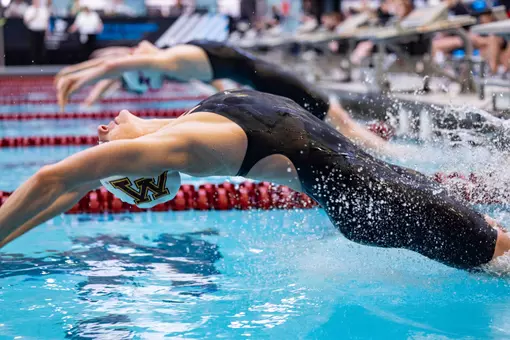
Smith steps up on the block. Total concentration ensues, as she goes through her final thoughts before breaking the water and embarking on her race. She does a final stretch and loosens her limbs, then leans forward, and grabs the block. Smith takes a deep breath, steadies herself, preparing to burst toward the water.
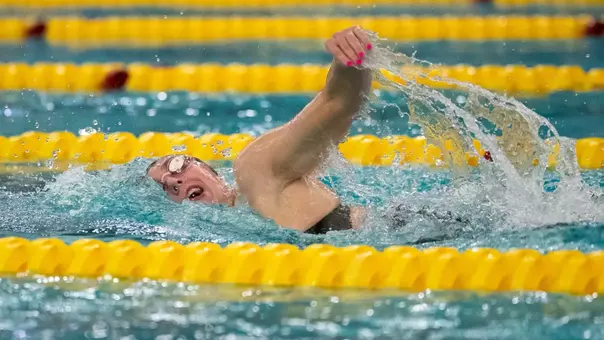
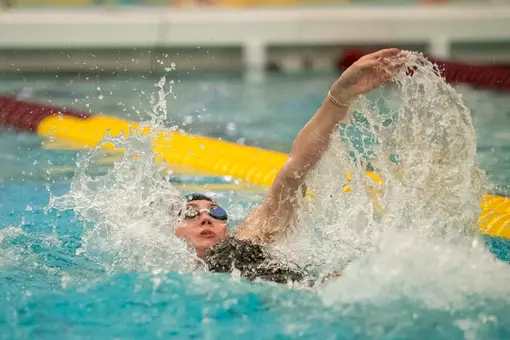
The crowd becomes silent in the moment before the gun sounds. It's a clean start. As she has done hundreds of times before, Smith immediately finds her timing and begins to cut through the water like a knife.
"If your timing is just a little bit off, you can be as strong as you want, but if you're splashing in the water, it's not going to work for you," Smith said. "You have to have the timing come together very perfectly."
On this day, Smith's timing was as good as it's ever been. She fought through the pain and burning in her muscles, especially during the second half of her race, to touch the wall in fourth place. As she turns to look at the board, her eyes widen in amazement and she smiles at the 2:23.32 displayed next to her name. The time is less than half a second from earning a spot on the podium, and is seventh-fastest in the world in 2014.
"After the Commonwealth Games, I had gone 2:25 and I was like, it's great to be at 2:25 again. I achieved most of my goals, I was happy, and then I went 2:23 at Pan Pacs and was like, that's unreal," Smith said. "I went 2:24 in the morning, and I remember looking up at the board and being so surprised. It was my happiest moment ever - besides the 100 breast and Big Tens last year, that's another very happy moment."
-- -- --
Smith's sweep of the Big Ten titles in the breaststroke events last February continued Minnesota's amazing success in the even in recent years. Former Gopher All-Americans Jillian Tyler and Haley Spencer dominated the events during 2008-13, and Smith added her recent feat to help Minnesota win its third consecutive team title.
Overall, the Gophers have won six of the past seven Big Ten titles in both the 100 and 200 breast, and Smith is quick to credit Head Coach Kelly Kremer for the improvement he's helped her make in the events.
"We train with mid-distance and distance freestylers, and I don't fully understand it, but it works," Smith said. "He (Kremer) has breaststroke drills that apply to each individual, and he'll alter them. For some of the drills, he'll tell me to do fly kick instead of flutter kick - he'll tell people to do different things for what suits them, and he's so insightful on what each person needs for their stroke and that's so important."
-- -- --
"When I came over to the women's side as co-head coach, the first NCAA qualifier Terry (Ganley) and I had in 2006 was Julia Quinn, a 200 breaststroke swimmer," Kremer said. "She dropped a huge amount of time to make NCAAs, and then we got Jillian Tyler. After Jill, it went to Haley, and now to Kierra. It's been good fortune."
In addition to their dominance in the breaststroke events at the Big Ten Championships, Tyler (100 breast) and Spencer (200 breast) each won an individual NCAA title in 2011, an accomplishment on which Smith now has set her sights.
Due to her performances on the international level, Smith's goals now far exceed success at the collegiate level. Her dreams are focused not only on an NCAA title, but on the 2016 Summer Olympic Games in Rio de Janeiro, Brazil.
"When you're seventh in the world, this is a good time to do it (train for the Olympics)," Kremer said. "Her improvement curve is as steep as anybody's. She's going to invest everything she has into the Olympic year - she won't be attending class, she's going to take the year off collegiately and really prepare for the Olympics."
Kremer said Smith will likely train at the University of Minnesota until January, 2016, before returning home to Canada to train with the national team leading up to the Summer Olympics.
"I think her improvement curve will only get steeper," Kremer said of her chances of reaching the 2016 Olympic Games. "She'll go by some of the people in front of her right now, and I don't see anybody behind her catching her. I think being on the podium is a very realistic goal. She is way past the point of dreaming about the Olympics. She's at the point where that's realistic."
"Making the Olympic team has always been my number one goal," Smith said. "Now, it's not only that, but I want to final at the Olympics in 2016. That's what all my efforts are going toward."
For now, Smith says winning NCAAs remains an important focus for her, one that has grown over the years. As a freshman, she admits it wasn't her most important goal. But last year's sixth-place finish in the 200 breast final helped her to realize it was within her reach.
"That was so much fun," Smith said. "Now, this year, it's all I want to do. This year I am just trying to win NCAAs, and then I will switch over to Canadian Trials, with two weeks in between."
Smith's training regimen with Kremer involves about 6,000 yards per practice, or 30,000 yards per week. For most people, that type of work would cause far too much pain and exhaustion. But Smith feels her ability to train hard and be able to work through any pain is what sets her apart from competitors.
"I've never been afraid of the pain. I expect it," Smith said. "I think I'm very good at the back half of my race because I don't fear it. Yeah, it hurts, but it's supposed to. I try to get there as quickly as possible."
"Kierra has a great stroke. It's different than the stroke that Jillian had, or that Haley had, or any male breaststrokers I've worked with have had," Kremer said. "It's different, but it really works for her."
Kremer says Smith's been good about making stroke changes when asked, and that she's good at feeling if something with her stroke isn't right. He adds that she's very coachable, which is something he believes is common for elite athletes and what makes them a little different.
When it comes to role models in the pool, Smith doesn't have to look far to find two great ones. Both Jillian Tyler and Annamay Pierse are multiple-time Canadian Olympians that Smith has always admired.
"Jillian was one of the main reasons I came to Minnesota. I wasn't set on coming to America when I first started looking at colleges," Smith said. "The reason I looked here was because Jill was here, and she had so much success. She and Kelly collaborated so well. Kelly goes up to Canadian meets and Jill didn't have any trouble training here and then training long course meters. I knew it would be a good decision for me because it was a good decision for her."
Smith said she also grew up with former world record-holder Annamay Pierse as a role model. Pierse was in Vancouver, and being a world record holder from Canada was impactful to Smith.
"Having Annamay as a role model really made me want to be good at breaststroke, and then I was lucky that it clicked for me and that it came so naturally," Smith said. "She was always so nice to me, even up to when I was 18 or 19 years old, she would still wave to me on the pool deck. I've always been a fan of hers. She's retired now, but I think having her support along the way has been super helpful."
-- -- --
Smith's mom and dad would do anything for her if it benefitted her swimming, which included long drives for their daughter to be able to train with Pierse.
"They would always send me to any swim meet that I had to go to. They would figure out a way to get me to those places, and they would always drive me," Smith said. "There have been countless times they have driven me to Vancouver to swimming meets, or to see Annamay, and it's a five or six-hour drive."
She also gives a great amount of credit to her coach with the Liquid Lightning in Kelowna, Emil Dimitrov.
"Emil has always believed in me, even when I wasn't as successful in breaststroke. He's always helped me see the more fun side of it, and never pressured me," Smith said.
"Kierra just has to continue to be herself. She's gotten past the point of education where you're trying to convince them how to be committed, and she's gotten through that," Kremer said. "She's very committed, focused, as coachable as you could be, and she's at that spot now where she really just has to be herself and she'll get there."
Three days in March will determine whether Smith can join Tyler and Spencer as the next national champion Golden Gopher in the breaststroke. After that, Smith will focus solely on international competition through the 2016 Summer Olympic Games though, surely there will be some time for Gwen Stefani along the way.
Michael Molde is a freelance writer in the Twin Cities. He can be reached at michaelmolde@hotmail.com.
Players Mentioned