University of Minnesota Athletics
Where Are They Now: Ryan Lefebvre
2/1/2016 12:00:00 AM | Baseball

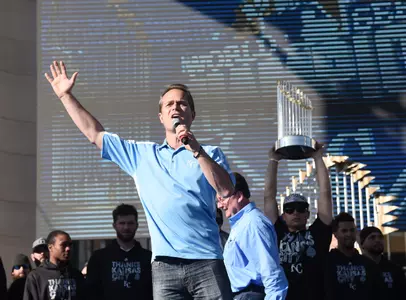
Ryan Lefebvre went from producing in pressure-packed moments as a Gopher to broadcasting those moments for the Kansas City Royals. (Photo courtesy Kansas City Royals)
Read the February 2016 issue of Ski-U-Mah here
While a life in baseball seemed like destiny for Ryan Lefebvre, the son of a former major league player and coach, and a standout centerfielder in his own right, the path from that first hit off the tee to calling the final out of the 2015 World Series hasn't been as direct as the base line from home plate to first base.
The first base line is one with which Lefebvre became very familiar as a player. As a high school star in Los Angeles, he drew recruiting interest up and down the West Coast, but a chance encounter between his father and long-time Minnesota head coach John Anderson brought Lefebvre to the Twin Cities, where he would become the Gophers' all-time hits leader. He's currently sixth on that list, one of six offensive categories where his numbers remain among the top 10 in program history.
A Cleveland Indian prospect after his college career, Lefebvre quickly left minor league baseball - "I hated every minute of it," he recalled with a chuckle - to pursue his other passion, broadcasting. Within two years, he was broadcasting Twins games and, in 1999, took a play-by-play job with the Kansas City Royals. After enduring more than a decade of losing seasons with the franchise, Lefebvre had the honor of being the first in 30 years to call the Royals "World Series champions" when he called the team's series-clinching win in the Fall Classic last October.
Q: How does a kid from L.A. end up playing baseball at Minnesota?
A: Boy, I've been asked that question a million times and it was just that all the stars lined up perfectly. My dad, Jim, was coaching the Oakland As. He met John Anderson at a college coaches' clinic and they hit it off. John invited my dad to fly to Minnesota and work with his hitters during the baseball offseason and they became friends. One year, they're in the coaches' office after practice and my dad just casually said, out of curiosity, "What are you guys looking for this year [in recruiting]?" The year before, JT Bruett had signed with the Twins. He was a centerfielder and a leadoff hitter. They missed JT and they were looking for a player of his type. My dad said, "That's interesting, my son is that type of player. He's being recruited. Would you be interested in watching him play or talking to him?" I think John and Rob [Fornasiere], just out of courtesy to their friendship with my father, said, "Sure, we'll give him a call and we'll look into him."
Q: So that opened the door to Minnesota, but how did you end up deciding to come to the Twin Cities?
A: Every other school that was recruiting me was on the West Coast. Minnesota was the only school that wasn't on the West Coast and I really had no intention of going to Minnesota. I just thought it would be a good experience [to take a recruiting trip there]. I thought, 'When am I ever going to go to Minnesota again?' I just felt surprisingly at home while I was there. It caught me off guard. I remember flying back to Los Angeles and the whole flight I kept telling myself, 'I think this is where I'm supposed to go.' It was fate.
Q: Though you had baseball aspirations, right from the time you got to Minnesota you worked for Radio K, didn't you?
A: I did, back before it was Radio K. When I was in school, it was a professional radio station run by radio people. They had a few students that helped out but, for the most part, it was a radio station that you could hear anywhere in town. Then there was [the student-run station] in Coffman Union. In the mornings before class, I would bike from the East Bank over to the Rarig Center and I would do sports updates in the morning on KUOM. Then, once a week, in the evenings, I'd go to the student station and I would do a one-hour talk show. I got a lot of really good experience.
Q: Did you know from the start - even with baseball - that you wanted to be a broadcaster or go into broadcasting? How did you balance that with baseball at the U?
A: It's probably one of the few mature things I did when I was 18 and 19 years old, having a big-picture perspective. I think it really helped me that I grew up in the game. I knew the failure rate of making it to the major leagues. At that time, I was like every other kid - I was going to make it to the major leagues - [but] I really did take my major seriously. When I went to college, I knew I wanted to major in broadcasting, but the play-by-play just kind of evolved over time. I thought I wanted to be a news anchor and I was talked out of that … I think I had a fear of being the typical jock that becomes a sports announcer. Then, when I was at KFAN [as an intern], I thought I would want to be a talk show host but I realized over time I just wasn't interested in all the sports like I needed to be. … My personality really lined up well with being a play-by-play announcer.
Q: What was your major in?
A: It was a combined major. I tell people it was a triple major, which sounds a lot more impressive, but it wasn't three separate major. It was through the College of Liberal Arts [and] I combined three departments: Speech Communications, American Studies and Sociology.
Q: With your experience in both, what's your opinion on which is a harder existence - being a minor league ballplayer or being on the lowest rung in the broadcasting industry?
A: They're both very similar. They both pay very little. Both industries are similar in that if you get to the top, it's a long way from the bottom. I think a lot of people look at a major league baseball player and in their mind they think, 'professional baseball player.' Well, a majority of professional baseball players are in the minor leagues, riding the bus, eating peanut butter and jelly sandwiches and playing on old fields. In broadcasting, if you're in a very small market, you're a one-man show. If you're doing a television story, you're hauling the camera out there, you're doing the interviews, you're shooting yourself, hauling the camera back to the station, doing your own editing, all for very, very little pay. …When I signed with the Cleveland Indians, I only lasted for two-and-a-half weeks and I quit. During my senior year, working at KUOM and working at the student station and doing some internships, I think I felt more gratification as an aspiring broadcaster than as an aspiring baseball player.
Q: Do you have a favorite memory or lasting impression from your time here at Minnesota?
A: When we won the Big Ten in 1992. That was something we could all enjoy. I think breaking the [career] hits record was neat for various reasons. Number one, John and Rob took a chance on me and they brought me in from Los Angeles and they didn't bring kids in from that far away. I felt good for them because they took a chance on me … but, in the end, winning the Big Ten championship, the whole team shared in that. I have a little office here at my house and I have a big picture of a couple teammates and me holding the Big Ten plaque that we won in Columbus. I still have my ring. That was far and away number one for me.
Q: What about your favorite moment as a professional broadcaster - was getting to call the Royals' championship this year the highlight of your broadcasting career?
A: For me, it was calling the final out of the World Series. To be the person who gets to say "The Royals are World Series champions." It happened to be that I was behind the microphone. It's not like I had anything to do with the Royals winning the World Series [but] I got to say it, which is a great honor because there are so many great broadcasters who have never been to a World Series, let alone call the final out. The parade, the rally, being on the field after they won Game 5 of the World Series and seeing so many people as happy as they were, it's like comparing the hits record to winning the Big Ten championship. [The championship] was something we could all enjoy together. Calling the final out of the World Series is just a very small piece to this much greater puzzle of what it's meant to Kansas City, the region and the organization.
Q: What importance did your U of M experience have in getting you where you are today?
A: To this day, I tell people the most important decision I ever made in my life was to go to the University of Minnesota. To follow my heart, get out of my so-called comfort zone, experience something new. … I tell people all the time, I was born and raised in Los Angeles, but I grew up in Minnesota. At the University of Minnesota, when media would come out and cover the Gophers, John made sure to introduce me to everybody, whether it was a radio personality, a television personality, a newspaper writer and let them know, when Ryan's career is over, he wants to pursue broadcasting. … Two years after I'm done playing, I'm broadcasting for the Twins. I was 24 years old. I think I was the youngest broadcaster in Major League Baseball at that point. I broadcast for the Twins for four years and that leads to a job with the Royals and I've been here for 17 years. For me, it all started when I took a leap of faith and I left Los Angeles and went to Minnesota.
Interview by Jake Ricker