University of Minnesota Athletics
Success Through Determination: Rower Rachel Sartor
10/28/2010 12:00:00 AM | Rowing
By Charlie Armitz
Athletic Communications Student Assistant
When Rachel Sartor’s mom told her to become a rower, Sartor wasn’t exactly thrilled about it.
“My mom was like, ‘You need a sport,’” says Sartor, a sophomore varsity rower for the Gophers. “She was like, ‘You should try rowing.’ And I told her no.”
Sartor, once a three-sport athlete in high school, had said that she wanted to try being a “normal student,” and that she just didn’t want to row. That was, until her mom dared her to.
“She was like, ‘I bet you can’t make it to [this Saturday’s practice],’” Sartor says. “And I was like, ‘I bet I can,’ and so I did.”
Two years later, she’s one of the top varsity rowers at the University of Minnesota.

The source of that improvement? Sartor’s determination.
“My mom always said I was a stubborn kid, and determined,” Sartor says, “so I think that just moved into [rowing] as well. . . . I stuck with it and it was great. It changed my whole course of life.’”
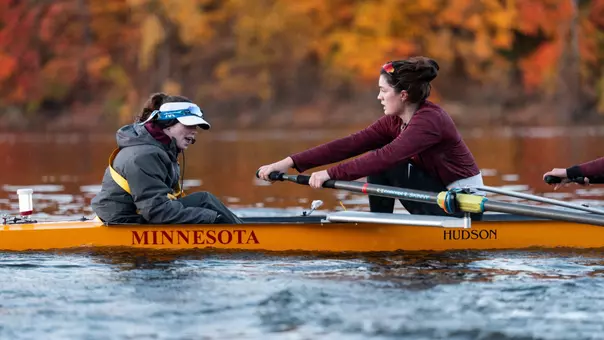
Ever since that fateful Saturday in 2008, Sartor’s rowing experience has been nothing but positive. When she arrived at the U of M in 2009, Sartor made the fall varsity squad with little trouble, despite her limited experience. Although the learning curve was steep, Sartor retained her varsity spot for the more competitive spring season, rowing as the two-seat in either the first varsity boat, which is where she rows now, or the second varsity boat. What got her through the learning curve, Sartor says, was teamwork.
“I love that [rowing is] a team sport,” Sartor says. “I wasn’t used to that in swimming—I mean, it was a team sport, but you could affect your own race. [In rowing], I can affect the race I’m in, but I also depend on seven other girls that are with me. I think I’ve thrived off of that. I love the teamwork and the dependency there.”
Rowing is also a very competitive sport, very similar to swimming in that regard. Contrary to what a spectator might observe, rowing requires constant activity and awareness from its participants. For Sartor, there is no greater dare.
“I love the intensity of it,” Sartor says. “There’s no breaks, there’s no stops. You just go from the start to the finish, [and] you go as hard as you possibly can.
“I think that’s the way I was wired,” she adds. “I like the more intense sports.”

Most people probably would not consider rowing an intense sport. Then again, most people don’t row. Nor do most people realize that rowing, despite its lack of exposure, physically and mentally stimulates an athlete as much as—if not more than—a popular sport like swimming.
Practices are a whole story of their own. There is no “typical” rowing practice at the U of M; rather, each day is dedicated to improving a few specific aspects—physical and mental—of rowing. While one day may be used to develop technique, another may focus on “race training,” whereby the rowers train against other boats to simulate the nerves and intensity of race day. Twice a week, the rowers will lift weights. Also twice a week, they will do their own four-mile runs to build endurance and recovery ability.
Such a regimen is enough to exhaust any athlete, even Sartor.
“Rowing is the most physically rigorous activity I’ve ever done,” Sartor says. “I think it’s comparable to swimming—the early mornings, the long practices, the fact that you can’t just stop, you can’t just give up. I think it’s more so in the fact that you have people depending on you. You can’t just let go of your oar.
“I’ve never experienced the kind of pain that rowing induces,” she laughs.
Sartor’s journey as a rower will come full circle this weekend, when she returns to her hometown of Princeton Junction, N.J., for the Oct. 31 Princeton Chase. There, she will row in front of her parents, her aunt and uncle, friends from high school, and one of her ex-coaches. And she’ll take it all in stride, preparing the same way she always does.
“We always go out and train as hard as we can,” Sartor says of her team. “I can’t pick out a certain week where I said I’m training harder now. I don’t see that [training harder because of added motivation] helps our team at all. I want to continually get better, and just the fact that I get the chance to be in the [first varsity boat] and compete in my hometown just makes it that much better.”

That’s not to say Sartor isn’t anxious to perform in front of her family and friends. She says she’ll feel the pressure; she just won’t let it get to her.
“I think the added pressure is that I know my mom’s watching, and she’s always really supportive, and I know my ex-coaches are watching, and they’re going to be like, ‘Wow, did she improve?’ and ‘Where is she at now?’” says Sartor. “But I’m just excited. I think [rowing in front of them] adds more excited energy instead of nervousness. And all the more reason to pull harder, right?”
Not that she needs the motivation. To come this far this quickly, Sartor had to be more than just motivated. She had to be determined. And she still is, even with her future goals undecided at the moment.
"I don't know quite where I want to go with [rowing]," says Sartor. "I'd love to try out for [the Under 23 team] and aim for [a spot on] the national team, if that's where I'm going. If not, I'd love to just use [rowing] and be a coach. It's always been one of my dreams to be a coach. I'll take it as far as is in God's plan for me."



Players Mentioned