University of Minnesota Athletics
Rowers Demonstrate Teamwork Off The Water Too
11/19/2010 12:00:00 AM | Rowing
Just do it.
That’s the motto for the University of Minnesota rowing team when it comes to community service. Don’t brag about it, don’t take pride in it, and don’t even talk about it. Just do it.
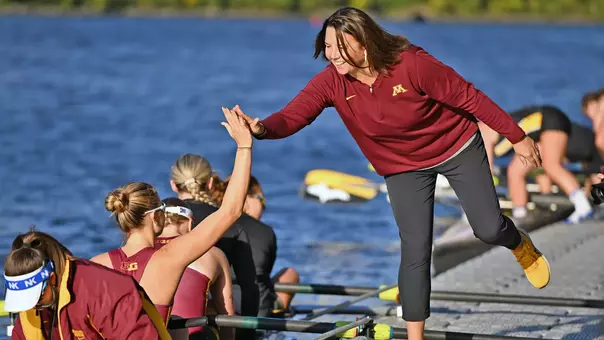
It’s an approach that seems to have worked well. This past year, the rowing team won the “Golden Goldy” award for a women’s sport, which is given to the U of M team with the most community service hours during the year. To 11th-year head coach Wendy Davis, such charity isn’t optional.
“It would be rude if we didn’t give back,” Davis says. “When you think about how fortunate we are in the U.S. to be at this incredible university and be allowed to be Division I athletes . . . It’s just selfish, and so you’ve got to give back.”

Although Davis makes her standards clear, she doesn’t force volunteering upon her rowers, and sees her role as “supportive.” She allows them to create their own standards—a strategy that has worked to this point, even when Davis isn’t involved.
“They’re very quiet about [volunteering],” she says. “I’m continually surprised at who’s doing the community service. They don’t talk about it. They just go out and do it.”
Such an approach might appear akin to that of a dissatisfied employee. But that’s hardly the case with the rowers.
“I just love doing it,” says Sarah Krueger, a fourth-year U of M rower. “It makes me feel good about myself, and it’s fun. If you’re having a bad day, it just makes it so much better. It’s just something that we can do to bond as a team.”
Krueger’s selfless attitude is a perfect example of what Davis has observed from her volunteer athletes in recent years.
“What’s interesting—and I think this is true for a lot of the sports—is that people will do community service and not even realize that’s what it is, just because it’s so ingrained in who they are,” Davis says. “I think some of that is [because] the state is big into community service, and a lot of the high schools have it as part of their curriculum. A lot of the athletes come in [saying] ‘What? I get credit for this?’ as far as counting toward the team totals.”
Such was the case with Krueger, who volunteered with Special Olympics kids in high school—and then discovered a whole new world of volunteering at the U of M. Since coming to the University, Krueger has found joy in volunteering for a number of kids organizations, including a series of events with HopeKids, a charitable organization that provides ongoing events and activities for kids with cancer. For Krueger, the HopeKids mission has a special connection.
“My sister actually had cancer when I was growing up,” she says. “She’s fine now—she recovered—but knowing what it’s like to go through [cancer] makes it easy [to work with cancer patients]. I can relate better to the kids, and understand their situation a little bit more.”
Krueger isn’t the only rower with family ties to community service.
“I’ve been doing it my whole life,” says Mikaela Rogers, also a senior rower. “My dad was really big into volunteering. He got us into it, so it’s part of what I do in my life.”
In 2007, Rogers’s dad was diagnosed with amyotrophic lateral sclerosis, a neurodegenerative disease better known as ALS, or Lou Gehrig’s disease. Since then, Rogers has led the team in participating in the annual ALS Walk at Lake Harriet, a charitable event that raises money for ALS research.
Fortunately for Rogers and the team, 2007 was also the year in which the rowing team gained access to the newly built University of Minnesota boathouse. With one integrated practice facility, rowers found their sport much more manageable, and their free time much better fit for volunteering at events such as the ALS Walk.
“Before [we got the boathouse], when we were operating out of the tent, it was so hard,” says Davis. “We worked out in three different venues, and where we went to get our sports medicine was in yet a fourth. There was just a lot more time taken up being a rower. But since we’ve moved into the boathouse, it’s freed up pretty much an hour a day for [the rowers] to be able to look elsewhere and say ‘Okay, what else can I do with my time?’
“We were always community-minded,” Davis adds, “but definitely it has picked up [in recent years].”
Davis also has her rowers to thank for that—in particular, Rogers, whose family has managed to make the best of her father’s illness, both personally and in the community.
“Her family is an incredible family,” Davis says. “Her dad is known in the community for ‘If you need a hand, he was there.’ When Brad was diagnosed with ALS, they’ve all rallied around, and everyone who knows them helps to support the family.”
That includes Rogers, who refuses to let the illness bring her down. Like her teammates, she just goes out and volunteers.
And she enjoys it too.
“I think a big chunk of [my motivation] is to be out there in spite of all that’s going on, in spite of how hard it is to live with it and all the sadness that comes with it,” Rogers says. “You can still have those fun moments and enjoy time with other people, despite the things that you’re going through. It’s not quite thumbing your nose, but kind of.”

But Rogers’s volunteer efforts extend beyond the realm of her father’s illness. In addition to doing the ALS walk and helping her father, she volunteers at other team events, including the annual “Feed My Starving Children” event in January. And in the true spirit of a giver, she volunteers at her church as well.
“It’s just really nice to be able to help other people and know that even doing small things are helpful,” says Rogers. “It just makes me feel good as a person to be able to go out and help someone else and do something that I know is beneficial for others. It’s totally selfless and it feels really good.”