University of Minnesota Athletics
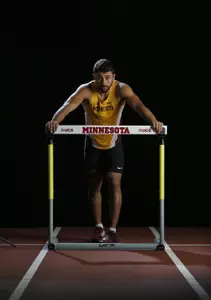
MULTI-DIMENSIONAL
2/1/2016 12:00:00 AM | Men's Track & Field

Ski-U-Mah Magazine Feb. 2016, Issue 11 | Cover Shoot Gallery
Story by Rick Moore
MINNEAPOLIS (GopherSports.com) -- When Luca Wieland was a youngster growing up on the outskirts of Saarbrucken, Germany, he played soccer. He also dabbled in gymnastics. And he was adept at table tennis, too.
But what sport was he most drawn to? "I couldn't decide because I was pretty good at a lot of things," he says. "So I wanted to do everything."
Not much has changed over the years, other than Wieland crossing the pond to take his athletic prowess to the United States and the University of Minnesota. He's still "pretty good at a lot of things," especially in track and field. Last year, the junior multi-event athlete won the NCAA heptathlon title with 6,070 points - the eighth-highest total ever by a collegiate athlete in the event.
He has his sights set much higher. He'd like to compete more on the world stage and dreams of making the Olympic team for Germany - ideally in time for the 2016 Olympics in Rio. After that, and perhaps simultaneously, he'll be on track to become a doctor.
Land of opportunity
Wieland hails from a small suburban community about 20 kilometers away from the big city of Saarbrucken. Compared to Minneapolis, he describes his town as much calmer and quieter.
He attended an elite prep school geared more toward athletes, which set him up to compete collegiately. "I always knew that I wanted to go pro in a sport, and I also wanted to do something academically like become a doctor," he said. "In Germany it's not possible to combine both really well because they don't have the system we have here where you can compete for the university; it's more like you have to do it separately and that gets really hard."
A coach from Wisconsin came to his school to introduce the U.S. collegiate system and Wieland knew that's where he belonged, although "finding the right school was a little harder," he said.
He used an agency and created an online profile and about 60 schools showed interest. An offer from Cal-Berkeley fell through and then he turned his thoughts to Virginia and Minnesota.
The more he learned about the Minnesota, the track team, and the coaches, the more Minnesota felt like the right fit. "It wasn't a decision that was super rational," he said. "I didn't have a lot of information. I kind of trusted my gut and my heart. …
"We have great academics. We have a great community. And I really like my team; we have good chemistry. I feel really comfortable here and I think that improves my performance."
Which is not to say that everything has been easy for Wieland. He knew what to expect in terms of appearances and scenery in America - "We kind of know how it's supposed to look [from TV]," he joked - but it was a difficult adjustment, nonetheless.
The language was the toughest part. "I came here and everyone was talking so fast, and I did not have the vocabulary they had," he said. "My coach picked me up from the airport and I did not understand much of what he said."
That translates to more than just missing words. "If there's a language barrier you don't want to talk that much and you're more quiet. You listen more than you talk and you don't engage as much in conversation," he noted. "In Germany I was pretty much extroverted. Here, I became totally introverted. The first year I didn't talk much. That was the biggest barrier I had."
"He has grown so much since coming from Germany two years ago," said Paul Thornton, the Minnesota coach who picked Wieland up at the airport. Thornton works with the jumpers, sprinters, and multi-eventers on the track and field team. "He's grown a ton, but he and I have grown a lot in terms of communication." And, he added, Wieland is "a lot of fun to coach."
A multitude of events
At about age 12, a coach and teacher in Germany told Wieland he should try track and field, and he finished third in his state at one of his first meets. Soon he was routinely finishing first, and started doing multi events at age 16.
Wieland finished second in his age group in the decathlon in the German national track championships at 17. "I was pretty pumped about that," he said. "That was the first meet where I was at that level nationally."
He's gained national prominence at the 'U' despite a hamstring injury that hampered him for the better part of two years.
"I'm an explosive kind of 'multi,' so sprints and jumps come easier to me, especially long jump, which is one of the best events I have. I became a really good high jumper, too, because of the practice here. And I became a really good thrower - the shot put, especially."
His Achilles heel, if he has one, is in the distance events - the 400, 1,000, and 1,500 - despite his best efforts and extra practice. "I'm sure I have to practice more than the others, especially for the 1,500 and 1,000, to become good at it."
But it's that multitude of events and the variety of his workouts that drive him. "Some events are just going to be frustrating at some point," Wieland said. "But then you always have another event where you can maybe do things better and get in a better mood. But you're always at the edge of doing too much, not doing enough, getting hurt, and becoming better."
"He's so engaged with how his body feels and is able to do these events, and he'll let you know how he feels or what he needs to do better" before you even need to address it, said Thornton.
In addition to the NCAA title in the heptathlon, Wieland is a two-time Big Ten champion, and last spring was the recipient of the Garry Bjorkland Award, given annually to the Gophers' most valuable competitor.
In December, he posted a nation-best 5,789 points to win the heptathlon at the indoor season opener and was honored as the Big Ten Field Athlete of the Week and the USTFCCCA National Athlete of the Week.
From track practice to medical practice
"Academics are more important for me than sports," Wieland said. "Maybe right now it doesn't look like it because the [higher level] academic stuff is going to be in the future and I want to be really good in sports right now. … You really have to find a balance. I'm not going to be a 4.0, but you do the best you can."
At 3.71, his GPA is nothing to sneer about. This past year Wieland was honored as a Capital One Academic All-American, just the fourth Gopher track and field athlete to earn those honors in the past six years. He's majoring in international business and marketing in the Carlson School of Management.
Despite the current focus on business, he's eyeing a future in medicine. He's not sure exactly what field he'll choose - his mother is a gastroenterologist and his father a psychologist - but he knows in addition to being a doctor he wants to add business savvy to the mix.
"I wanted to get insight into the business world to build my own practice at some point," he said. "In the capitalistic world of today, a business degree will help me with that a lot."
He also plays guitar and sings. He shared his talents with his fellow Gopher athletes at the last two Golden Goldys award ceremonies. He's in the singer-songwriter realm, a la Ed Sheeran, with skills he picked up from his uncle.
Playing guitar is "just something where I can forget about sports and forget about school," he said. "Sometimes when you're stressed out you just want to do something completely different, and I really enjoy music a lot. I couldn't survive without playing the guitar once in a while."
But no, he's not a "multi" when it comes to instruments. In his freshman year he tried playing the piano at Sanford Hall, but figured he didn't have time to add that to his resume.
"He can do all these things, but he has all these other goals in life that are even better," noted Thornton. "He's going to reach all of these goals because of how motivated he is."
Perception…and ranking greatness
To a new acquaintance, Wieland seems measured and reserved, if not introverted. He kicks back in an easy chair and comfortably handles every question thrown his way with a vocabulary that belies any trouble he had with English when he arrived here in the summer of 2013.
He's not exactly sure how people perceive him, but has the sense some people think he's quite serious, maybe even a bit full of himself. "When you have success, people will think, 'He's a little cocky,'" he said. "I know that I'm really not. … People who know me best know I'm not that serious about myself."
But he's obviously proud of being a multi-event track star, and has no disagreement with people who think decathletes are the greatest athletes.
"I definitely agree with that. It's always hard to compare sports; there are different aspects in each sport, but I guess the decathlon would be the best guess for the best athlete because you have sprints, you have jumps, you have throws, and you have the longer distance [events]," he said. "You have to do all those movements and you have to practice a lot. … All this combined is a complete package."
He runs through some of the other sports and notes their unique demands of athleticism - the explosiveness of an NFL wide receiver, the size and skill of an elite basketball player, a male gymnast doing the iron cross - and starts to back off a bit, for a moment, on that proclamation.
It's really hard to make that comparison and unfair to a lot of sports, he notes. But… he smiles, "I think decathlon is the best guess."

Players Mentioned